

· Charlie Holland · Architecture · 7 min read
You Can't Buy Your Way Out of Your Own Org Chart
Electricity was commercialised in the early 1880s, and for forty years it barely changed what a factory could get done, because owners bought the new power and kept the old floor plan: same shafts, same belts, same layout, a different engine. We've just done the same with cloud, and we're lining up to do it again with AI. When anyone can buy the capability, what's left to compete on is the shape of the organisation using it.
There’s a loch not far from here whose water used to run the other way.
Loch Doon sits up in the hills in East Ayrshire, and until the 1930s it drained north, down the River Doon and out to the sea at Alloway. Then the Galloway Water Power Company dammed it, raised it and turned it round. Eight large dams, five power stations, four tunnel systems, finished in 1936. Six years, start to finish, for a thing that would spend a decade in public inquiry today.
Now it’s just part of the grid. Water goes through the turbines at Tongland, the electricity goes into the same wires as everybody else’s, and nobody boiling a kettle in Ayr knows or cares which of it came off the hills above them.
Forty years of nothing much
Electricity was commercialised in the early 1880s, and for something like four decades it made very little difference to how much a factory could get done. The economist Paul David worked out why in a 1990 paper, The Dynamo and the Computer, and the answer was the floor plan.
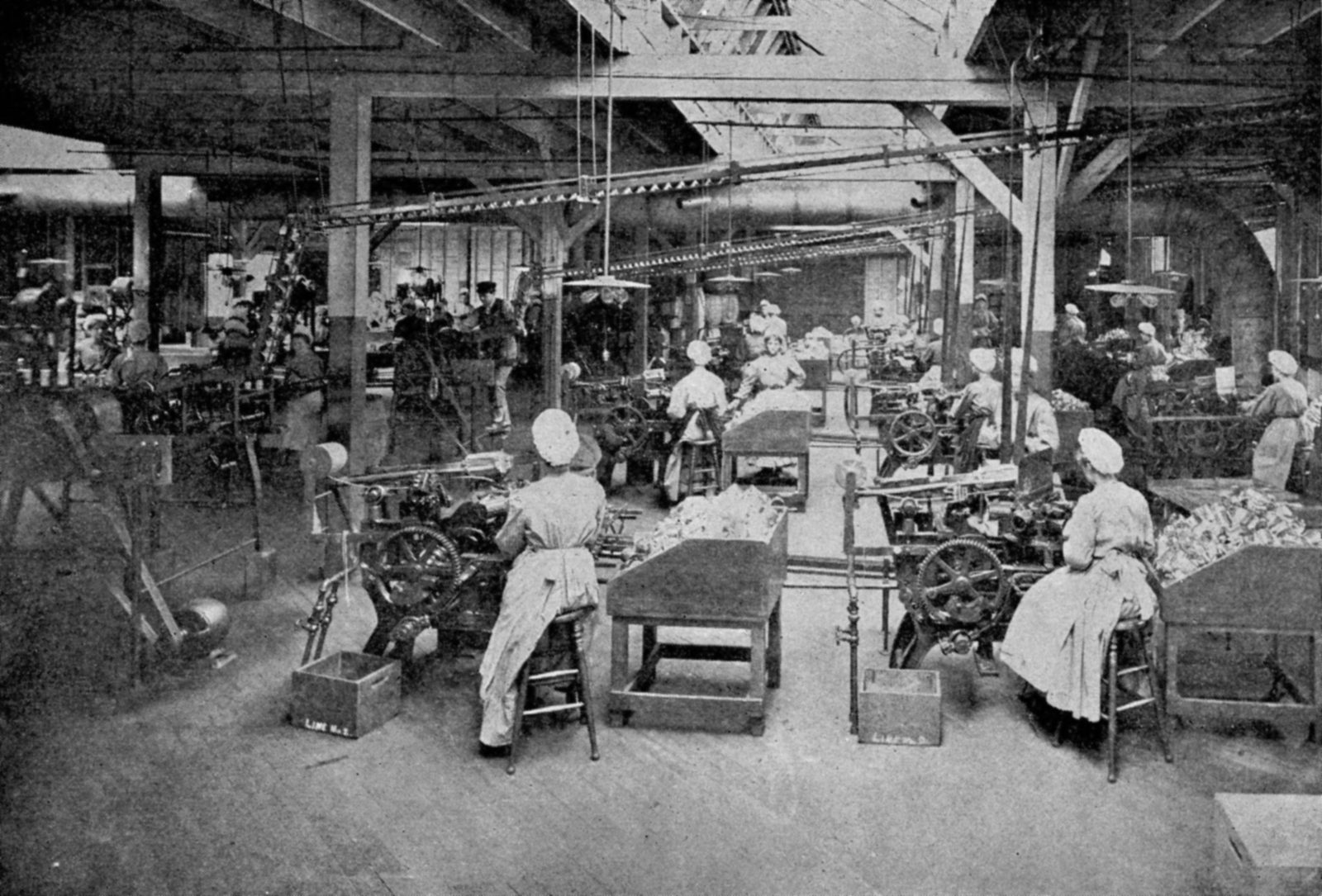
A steam-powered factory was built around one enormous engine. Line shafts and belts carried the power out to every machine, everything turned at the same speed, and machines were positioned by how close they needed to be to the shaft rather than by the order the work passed through them. Factories were several storeys tall because stacking floors was how you got the most machines near one engine.
So when electricity arrived, owners did the sensible thing. They took out the steam engine, put in a large electric motor, and drove the same shafts, the same belts, the same layout. It worked, and it saved a little on fuel, and it changed nothing else.
The gains came later, when somebody worked out that if every machine has its own small motor then the shafts can go entirely. Once the shafts go, the building can be a single storey, the machines can be arranged in the order the work actually flows, and an operator can start and stop their own machine instead of the whole line. That’s the unit drive. It spread in the 1920s, forty years after the power arrived, and that’s when factories finally started getting more out of the same day.
We just did this with cloud
Cloud was the same trade, and I was on the delivery end of it. Somebody else owns the power station, you pay by the hour, and capability that used to need a data centre and a team of people arrives on a credit card. It changed what was possible, and I’ve made a decent living helping organisations take it up.
Most of them bought it and kept the floor plan. The same four teams, the same change advisory board on a Tuesday, the same six-week lead time to get an environment, wrapped around a platform that creates one in ninety seconds. We even had a name for it, lift and shift, which is the electric motor driving the old shafts.
I’ve written before about the multi-cloud story people tell their boards and about what serverless actually costs once it’s real. In both cases the technology did what it said, and the organisation using it stayed the shape it was before.
The fastest computer in the world
Years ago I worked for Digital, and we sold the Alpha. Some of those machines were built up the road from where I’m writing this, at Digital’s plant on the edge of Ayr, which had been turning out computers since 1975 and is a business park now.
The 21064 shipped in 1992 at 200MHz, at a time when Intel’s Pentium arrived the following spring running at 66. It went into the Guinness Book of Records that October as the fastest single-chip microprocessor in the world. If you needed serious compute in 1992, the kind of modelling or simulation that justified a purchase order with three signatures on it, this was the machine, and there was a waiting list.
The phone in your pocket has more compute than that entire desktop, and it comes free with the contract.
Generative AI is on the same curve. Running a decent model today means renting somebody else’s GPUs: expensive, centralised, and it needs a purchase order, which is where the Alpha was in 1992. Give it a few years of ordinary progress and a fair chunk of that work runs on hardware already in the building, then on the laptop, then it’s just a thing your machine does, the way it encodes video without anyone bragging about it.
The last post left a question hanging. If the thing that finally does the coordinating ends up as ordinary as a graphics card, what’s left to compete on?
What money can’t get you
If the capability is a utility, a large company can buy everything a small one has. Same models, same tools, same price list, and the large one gets the better discount.
What it can’t buy is a different organisation. It still has everything it accumulated on the way to being large: the reporting lines, the four teams that have to agree, the board that meets on a Tuesday, the handovers, the sign-offs, the eleven people who each own a small piece of a decision. None of that was stupid. Every part of it was a reasonable answer to a real problem, usually a problem involving something going badly wrong once, and I’ve spent most of my career being brought in to work inside it. A small operation has less of it, with fewer people between a decision and the work, and no vendor can sell you that.
From 2001, Borders ran its online bookshop by handing it to Amazon, who operated Borders.com on its behalf for the next seven years. On paper it was a sensible piece of outsourcing: buy the capability from the people who are best at it, keep your own staff focused on the shops. Borders took the site back in 2008 and filed for bankruptcy in 2011.
So Borders got the technology, and bought it from the company that was killing it, because buying was a procurement decision and building would have meant becoming a different sort of company. It stayed a chain of shops run by people who ran shops.
Every large organisation half-knows this, which is why they all have a programme about it. Transformation, or ways of working, or operating model. It runs for three years and produces a new org chart with the same number of handovers arranged in a more attractive pattern.
What will actually happen
Most organisations won’t do this, because the roles that would have to go belong to the people who’d have to approve it.
So it’ll go the way electricity went. Some will rearrange. Most will bolt the new motor onto the old shafts, run it for a decade, and report a productivity gain that never quite shows up in the accounts. And a few small companies, with no layers of sign-off to strip out because they never had any, will turn out work that a company ten times their size can’t match. Everyone will put that down to better technology, but they’ll be using the same tools as everyone else.
The Galloway scheme took six years to build and it’s been running quietly for ninety. Every hill in Scotland has water in it. What that one had was somebody willing to turn a loch around.


